10 Phone Interview Tips That Will Land You A Second Interview

By Gage Hanson

            Nobody likes phone interviews. Not exactly a controversial statement, but one that needs to be said nonetheless. There is a prevailing idea that everyone has that everyone else is great at talking on the phone. It isn’t true. So, when you have to interview on the phone for a job, an increasingly common event, how do you do well? Well, here’s 10 phone interview tips that will land you a second interview.

10 Phone Interview Tips That Will Land You A Second Interview

1. Make Sure Everything Works

            This step is absolutely crucial. I can’t tell you the amount of times I’ve been on a skype chat, conference call, or digital meeting where I haven’t been able to pay attention because someone’s microphone is crackling or where someone had to ask “what did you say?” half a dozen times because their speaker was less than stellar.

            I recommend testing your phone by calling a friend the day of the interview to ensure that they can hear you well and you can hear them just as good. I also recommend keeping your phone charger nearby. If possible, use a microphone enabled pair of headphones. This will allow you to hear your interviewer clearly and higher quality headphones will have a microphone that is probably better than your phone’s. While not crucial, these will help the interview process go smoother.

2. Environment is Key

Do not do your interview outside or in a public place. Ever. You may think that a coffee shop is a good place to calm your nerves or a park is a quiet environment, but they have too many negatives to outweigh the positives.

            The slightest bit of wind will be heard by the interviewer and you may not even realize how much your questions are being cut out. Even in a public place inside you have no control over what sounds will be happening or how loud your environment gets. It is best to stay in a trusted environment indoors, most preferably your room or home.

Tips for second interviews - dress for success
Dressing to impress is important for second interviews

3. Dress to Impress, Really

I recommend that you wear the same exact outfit you would wear for your in-person interview. Don’t think that you can do your interview in nothing but your underwear. You can technically do it, but your mindset and confidence won’t nearly be the same. Dress your best and your interview skills will improve.

4. Prepare a Cheat Sheet

            One of the major benefits of over the phone interviews is the same exact benefit of an open book exam. You can have notes in front of you. You can pull up your resume to know what your best speaking points will be. This interview tip will be one of the biggest game changers in increasing your chances of landing a second interview.

            I suggest that you compile a note sheet of all your main talking points and the aspects of the company that excite you the most. These will all come in handy while you are talking. You won’t have to wait ten to fifteen seconds after every question to remember what you want to say. It would be a good idea to keep these notes to one page. Flipping through pages and pages of notes will be just as detrimental as not having any notes at all.

5. Slow and Simple

This tip works for in person interviews as well, but it is easier to fall into the problem it solves in phone interviews. People often speed up while talking on the phone. They get nervous, their heart speeds up, and they talk too fast. While interviewing in person you can pick up on clues and follow your interviewers pace easier, but you don’t get that benefit over the phone. So make sure to focus on your speed. You will feel like you are talking too slow, but that means you are speaking at exactly the right rate.

6. Active Listening

It is easy to start zoning out while you are interviewing on the phone. You can be distracted by what is going on around you, by something you see in your house, by a screen in front of you. Whatever it is, you have to divert your attention back to the interview. A good thing to do to ensure that your attention doesn’t wander is to try and form questions based on what your interviewer is saying. These questions will accomplish two things. You won’t be distracted and fumble through your interview, and your questions will impress your interviewer by showing interest and initiative.

7. Study Beforehand

While making your study sheet, you would also benefit from doing some studying. As much as you think your studying days are behind you now that you are searching for jobs, you are quite wrong. Studying common first interview questions and excellent answers to these questions and finding out more about the company you are interviewing for will make you stand out amongst all the applicants. Many applicants will stutter through generic answers. You can study and give specific, rock solid responses to impress your soon to be employer.

8. Practice makes Perfect

Another tip that works for regular interviews, this tip is doubly important when you have to talk on the phone. Lots of people practice what they are going to say before a regular phone call, so why shouldn’t you practice before a phone interview? It wouldn’t be out of the question for you to practice common interview questions over the phone with a close friend or family member.

second telephone interview tips.
Practice makes perfect when it comes to second interviews

9. Prepare Questions

While you are researching the company you are interviewing with, it would be wise to jot down a quick list of questions you think you could ask your interviewer about the job or company at the end of your interview. It is common to ask an applicant at the end of the interview if they have any questions. Simply saying “no” may come off as you not having any interest or deep desire to work in this position. Prepare 3-5 good questions that you could ask.

10. Check your Voicemail

The easiest of all these tips could also spare you the most embarrassment. I know a lot of people that haven’t changed their voicemail since they got their first phone in middle or high school. Imagine the voicemail you set up in high school being the first impression your interviewer gets if you somehow miss their call. Not the worst thing in the world, but also something you can easily avoid. Good luck.

This Guide ie one of our exclusive Guides. Checkout our other exclusive Guides found only here on LincOn.com.



Ship Tracking – American Phoenix

Ship tracking is a way of tracking ships anywhere in the world. The American Phoenix is a popular vessel to track because it is one of the largest ships sailing under a U.S. flag. Ship Tracking American Phoenix can be done on a number of sites including Vessel Finder, MarineTraffic.com and others. Here’s the latest position courtesy of Vessel Finder:


The American Phoenix is an apt name because this tank ship started as Jones Act tanker (see below) but Shell abandoned the project. Years later it was resurrected and “Phoenix” once again rose from the ashes.

What is the Jones Act

The American Phoenix is a vessel built under the guise of the Jones Act. The Jones act was passed in 1920 and requires that all vessels carrying traffic between American ports need to owned and crewed by Americans and the ship needed to have been built in the U.S. This protects the U.S. Maritime industry and vessels like the American Phoenix are proof of that.

American Phoenix

About the American Phoenix

As mentioned above, the American Phoenix was a ship whose construction was started by Shell Oil but the project was later abandoned. The tanker project was later resumed. At the time of launching in 2012 it was the largest ship ever launched in Alabama. It features twin engines, individual crew quarters and meets all engineering standards for vessels of its type.

Ship Tracking

Ship tracking ships like the American Phoenix is made easy by only tools that receive location information from hundreds of thousands of vessels on waterways across the globe. Ship tracking American Phoenix can be done via Websites that relay this information. These ship tracking sites include:

These sites let you see all shipping traffic on waterways around the world. This includes commercial and private vessels. The map below is a live tracking map of shipping around the United States. Use the interactive map to track vessels like the American Phoenix:


Hopefully this information has been helpful. Be sure to check out our other exclusive Guides found only on LincOn.com


Why is Amtrak so expensive

Anyone looking at Amtrak’s fares might do a double take, particularly when looking at long distance overnight accommodations. So why is Amtrak so expensive? There are a number of factors to consider starting with the fact that Amtrak needs to cover all of its expenses and receives few subsidies to support itself. This means what it charges for its services need to cover all its expenses including fuel, equipment, facilities and personnel needed to operate all of those including retired personnel.

Amtrak Train

Operating Expenses

Amtrak has a number of operating expenses from the fuel that they use to power locomotives, the personnel who operate and maintain them and the facilities in which they operate in. All of these need to be factored in when thinking about the per mile cost to operate.

Mile per mile, Amtrak’s operations in the Northeast pay for themselves and even make a profit for the railroad. However, those aren’t there only operations. They have trains that they operate all across the country.

Fuel

The fuel that Amtrak uses to power its locomotives is going to be one of their larger expenses. Outside the Northeast Corridor, most of the trains are powered by diesel locomotives. Believe it or not, they are technically electric because giant engines generate electricity and power electric motors that in turn drive the wheels. They also supply power to the entire train or consist.

In the Northeast Corridor the “fuel” that Amtrak consumes is electricity and a lot of it. From Boston to Washington the lines are electric. Instead of generating the electricity to drive the motors, they draw the electricity from the grid. As a commercial user, they draw large amounts of electricity that needs to be paid for.

Once all expenses are accounted for, Amtrak can then look at their income opportunities and forecast how much they expect from each of those along with how much the market will bear.

Personnel

Many employees of Amtrak work behind the scenes
Many Amtrak employees work behind the scenes.

Amtrak employs a wide variety of staff for their operations:

  • Conductors
  • Engineers
  • Baggage Handlers
  • Ticketing staff
  • Police
  • Mechanics
  • Cleaners
  • Track Maintainer
  • Markerting
  • Human Resources
  • Office Staff
  • Painters
  • Metal Shop
  • Signal Operations

Facilities

Amtrak doesn’t operate in a vacuum. Its trains operate out of stations and staff need to operate out of offices and maintenance facilities. All of these need to paid for, whether they are leased or owned by the railroad.

Amtrak staff cleaning trains
Amtrak staff have extra cleaning duties.

Maintenance

Both the facilities and the equipment that Amtrak uses need to be maintained. This requires personnel or hiring contractors to come in an performed the required tasks.

Income Opportunities

There’s a number of income opportunities for Amtrak. These include their Rail Operations and Facility Leasing.

Rail Operations

Amtrak’s rail operations are their bread and butter. They own their own lines in the Northeast but elsewhere they need to lease the use of the lines from freight companies. The freight companies take priority and so it can delay Amtrak’s operations in these areas.

Amtrak passengers in the dinning car
Amtrak’s passenger service is its primary means of income

Passenger Service

Amtrak’s primary service is obviously passenger service.. This includes moving passengers on their own inter-city lines or acting as an operator for some regional rail like Connecticut’s CT Rail line. In addition to passenger fares they can take in income from ancillary services like meals, drinks and overnight accommodations on longer trains.

Shipping Services

Amtrak currently offers shipping services for products loaded at one station and having someone else take them off at another station.

Rail Rentals

Amtrak also allows people to pay to have their privately owned rail cars towed from destination to destination.

Facility Leasing

Amtrak owns several stations that it operates out of and so can lease space to other other operators such as regional rail and bus lines like Philadelphia’s 30th Street Station. This presents another income opportunity for the railroad.

Conclusion

Once Amtrak know how much their expenses are, they can look their income opportunities and determine what the rates should be. It’s a simple equation at this point – divide the miles that they operate by expenses and determine the cost to operate by mile. From there you can figure out the fare between stations but you have to keep what the market will bear for different segments. For example, if they charged what it really cost for a 1000+ mile journey, few people would take it but if you increase your cost on other more well traveled lines, you can lower your cost on those longer lines and have more passengers.

There’s a lot of different things that get factored in to make Amtrak’s fares what they are but when you think about why is Amtrak so expensive and everything that they do, their fares do make sense.

Does this answer your question? Hopefully it does. Please check out our other exclusive Guides found only on LincOn.com.


How To Make And Repair A Fishing Rod In Minecraft

Fishing in Minecraft has changed so much over the years, but it is still one of the best ways to gather food when there aren’t reliable sources of meat nearby. There will always be bodies of water in Minecraft. Even if you’re stuck in a seemingly endless desert biome, there’s bound to be a small body of water or two. When you stumble upon water and notice your food bar getting low, it’s time to whip out a fishing rod and practice patience, but how do you make a fishing rod in Minecraft?

Minecraft fishing pole

How To Make A Fishing Rod

If you want to make a fishing rod in Minecraft, you will have to get three sticks and two strings. That might sound easy enough, but facing spiders might feel like a daunting task if you’re still at the beginning of the game.

Crafting a fishing rod in Minecraft

Fortunately, you usually come out of a death battle with an annoying jumping spider with a string. Hopefully, you survive spider encounters long enough to get the necessary number of string you need. Take the sticks and put one in the last block of the first row, the second block of the second row, and the first block of the third row. You would then put a string in the third block of the second row and the third block of the third row. However, like other tools, your fishing rod will lose durability after multiple uses.

How To Repair A Fishing Rod

Repairing a fishing rod in Minecraft

Repairing a fishing rod in Minecraft is as easy as repairing any other tool in Minecraft. If you have multiple fishing rods, you open up the crafting table or a grindstone. Place one fishing rod next to the other, and it will repair based on the durability of both items combined.

It’s a great way to repair a fishing rod if you don’t want to have to keep slaughtering spiders just to keep your inventory of fish up.

This guide is just one of our exclusive Guides. Checkout our other exclusive Guides here on LincOn.com


Best Ways To Allocate More RAM In Minecraft

Minecraft might look simple enough, but it is one of the most hardware-intensive games out there. You’ll notice how intensive Minecraft can get when you start using different texture packs, shaders, or even basic redstone builds.

Vanilla Minecraft can get stale after playing for so long, so people end up turning to modding. Unfortunately, without the proper amount of RAM, Minecraft will end up stuttering or even crashing. Fortunately, Minecraft makes it pretty easy to allocate more RAM to the application. These are the best ways to allocate more RAM in Minecraft.

allocate more memory to minecraft for better performance.

Allocate More RAM Through A Mod

Minecraft memory settings

If you’re using modpacks then, chances are, you’re using ATLauncher (which itself is a mod). ATLauncher makes it easy to mod the game without having to mess with different folders and installation headaches. ATLauncher also makes it easy to remove packs without messing up the game.

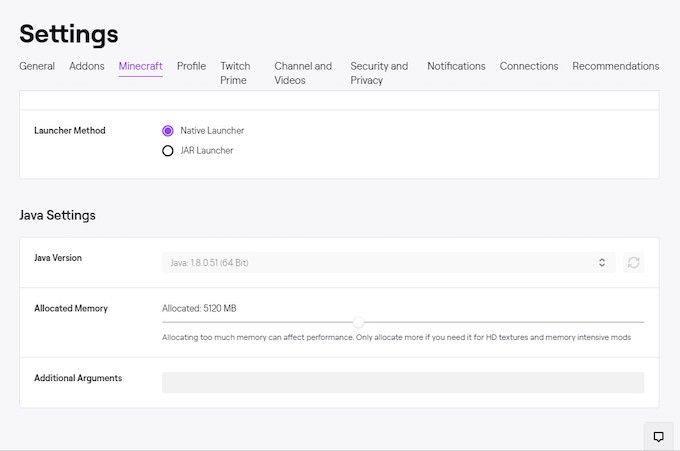
Fortunately, ATLauncher also makes it easy to allocate more RAM in Minecraft. Simply open the ATLauncher app, navigate the settings, click the Java/Minecraft tab, and use the arrows in the “Maximum MemoryRAM field” to adjust how much RAM you want to use.

Allocate More RAM With The Default Launcher

Minecraft launcher memory settings

If you’re not a fan of mods, but Minecraft is still crashing on you merely using the vanilla game, you can allocate more RAM directly through the default launcher. Often, people don’t play around in the default launcher. They think everything is good to go, click play, and start exploring. However, the default launcher can help solve a lot of technical issues you may be having in Minecraft.

To allocate more RAM using the default launcher, you simply open the launcher first. After that, you navigate your way to “installations” along the top, hover over the most recent version of the game, click to expand on the right side where you will see an option to “edit.” Once you’re on the edit installation screen, you’ll see “JVM arguments” at the bottom. The code might look confusing, but you’d simply need to change the “2” in the code to however much RAM you want Minecraft to use.

Hopefully, these tips will help you until you’re able to purchase more RAM for your system.

This article is just one of our exclusive Guides. Check out our other exclusive Guides found only here on LincOn.com.



Easy Ways to Catch More Fish

A wise old man I used to fish for Musky with when I was younger told me one day, “10% of the fishermen catch 90% of fish”. Whether that’s accurate or not I can’t say, but the more I have thought about that over the years, the more I think he really was onto something with that statement. Fishing can be a complex affair and some species are easier to consistently catch compared to others, but at some point no matter the species, fish just do not want to cooperate. In this article we will discuss some great tactics to improve your time on the water, despite the species.

old man fishing

Do your Homework

This is one of the most paramount parts of being successful on the water, you have to do your due diligence on the species you wish to pursue and really study up on that particular species, habitat, habits, forage base, locations at different times of the year, and more. Knowing the fish in and out is extremely important, do your research online, read about it in fishing magazines. There are an absolute ton of resources at our disposal today, and the average person has more information in their pocket thanks to smartphones than any human being in history. While you can study and research your preferred fish species at will, there really is no substitute for experience on the water. I have always told my Guide Clients, “Fish don’t read magazines“ and this has always been my way to show my clients in the boat that you need to adapt and think outside the box from standard tactics and presentations on a regular basis.

learn the waters

Learn the waters

You won’t catch fish if you don’t know where they frequently spend their time, this changes with weather patterns and seasons. GPS units have really changed the game if you’re on larger bodies of water, giving the angler the ability to set waypoints on structure such as drop offs, points, humps, brush piles, rock piles etc. along with the GPS modern sonar including side imaging has changed the game, giving anglers a precise picture of what’s below the surface, and even allowing the angler to distinguish between vegetation types, like milfoil or cabbage. My rule for any angler fishing a new body of water, is to spend a good portion of your trip without a rod in your hands, I frequently fish new lakes and depending on the size, spend multiple hours zig zagging over breaklines, mapping and exploring, and looking for baitfish. This process helps me eliminate dead water, and allows me to focus on the best looking structure and areas I want to spend my efforts on.

Find the Bait Find the Fish

This tip is predominantly for predatory species but certainly applies to prey fish like bluegills and crappies as well. This goes back to the rule of “you won’t catch fish if you’re not putting your bait by fish”. Baitfish congregate in different areas throughout the day, and season depending on weather conditions. If you find big schools of bait fish one day, chances are they are gone the next, so finding the food on every trip should be a major consideration. The general rule of thumb is if you find bait, the big fish aren’t far away. For panfish species and the like, this is also true, bug hatches for instance are an indicator of potential feeding activity Here in northern Wisconsin it’s well known that during the mayfly hatches in spring fishing can become very tough due to the overwhelming amount of available food for fish like panfish and trout. You can also see bug activity on your sonar, in the evening larvae and bugs from the bottom of the lake will rise in the water columns in certain areas. This can also make fishing a feast or famine affair.

Trout fish on hook

Don’t Leave Fish to Find Fish

This saying in the Musky fishing world is like holy scripture, but it applies in many cases to all fish species. If you’re on a spot that is normally successful, and are catching or seeing fish but not catching them, it’s usually only a matter of time. Fish feeding moods can change quickly, so if you know the fish are there, don’t leave to try different spots, or if you do, make sure your back on that spot at peak feeding times or if any type of weather changes occur. I know this might sound like common sense, but I see people do this on a very regular basis. In one instance on the water, I fished a 300 yard stretch of a lake for 6 hours straight, casting up and down nonstop and never left to fish another spot. I contacted 9 muskies but couldn’t get any of them to commit until moonrise when I finally hooked into a 48 inch fish. Persistence pays off.

This guide is one of the exclusive Guides on LincOn.com. Check out our other exclusive guides on LincOn.com on many subjects.


What Is A Waterlogged Toolbox In World of Warcraft?

In the second big content patch of the Battle for Azeroth expansion for World of Warcraft, the waterlogged toolbox was added. It can only be purchased by a secretive (but friendly) Murloc in World of Warcraft.

What Is A Waterlogged Toolbox In World of Warcraft

Of course, like any mysterious new NPC, you’ll have to do something for Mrrl first before you can access his goods. Unfortunately, when you find Mrrl, he isn’t in the best of shape, and you need to escort him to the safety of his lair in a quest called “A Safer Place,” with his other friendly Murlocs. It’s a relatively easy mission as there is very little danger to him. If anything, he should be escorting you as you’re the one who can die while escorting Mrrl, but he simply respawns if you happen to be bad at escorting missions.

Once you’ve helped him out, then he’ll make himself available to you as a vendor. However, you will have to purchase common items from his Murloc friend Hurlgrl, Flgrrl, Grrmrlg, and Mrrglrlr. Try saying those names five times fast.

Unfortunately, it doesn’t end there. If you want to grab a waterlogged toolbox, you would need to have access to the Azsh’ari Stormsurger Cape. It might give some decent critical strike and haste at L120, but you’re wanting it to have access to the Murloc traders’ special stocks when it is equipped. Once you have access to Mrrl’s special item table, you can see the Waterlogged Toolbox, but what does it give when you open it?

Opening a Waterlogged Toolbox from Mrrl gives you access to various Nazjatar items like a chum, but if you already have one of those items in your inventory, you won’t open the box. If you already have the item, then you’ll receive a, “You can’t do that right now,” message.

Just make sure you purchase items from all of Mrrl’s friends before letting you buy the Waterlogged Toolbox.

This guide is one of exclusive Guides found on LincOn.com. Checkout out other exclusive Guides found only on LincOn.com.


Kinetic Log Splitters

Kinetic log splitters use a build-up of kenetic energy in large springs and release that energy on a log to quickly split it. It takes about 2-4 seconds to split a log. This difference between how they work and gas or electric powered log splitters or even hydraulic manual log splitters sets them apart. However, they do have their drawbacks.

How do kinetic splitters work

Typically, log splitters work by pushing a hydraulic ram. The ram is powered by a pump that pumps the hydraulic fluid. However, that’s not how kinetic log splitters work. Kinetic log splitters work by taking the engines power and coiling large and powerful springs. This energy is then released all at once on a log.

Advantages/Disadvantages of Manual log splitters

Like anything else, there are advantages and disadvantages to using an kinetic log splitter. These may or may not affect you but should be taken into consideration when purchasing a log splitter.

Advantages

  • Speed
  • No hydraulic fluid
  • No pumps

Disadvantages

  • Cost – More expensive
  • Cannot be operated vertically
  • Does work as well on logs with knots

Kinetic Log Splitter Models

There’s not a lot of kinetic log splitters on the market but here are some to consider.

DK2 Kinetic Log Splitter

DK2 Kinetic Log Splitter

The DK2 kinetic log splitter features a 7 HP Kohler engine and an over-sized table beyond the wedge. It also have a 1 second cycle time. You read that right – 1 second!

DR Rapid Fire Log Splitters

DR Pilot K10
DR Pilot K10

DR Equipment has a several kinetic log springs with models ranging in power and ones that are powered by electric motors so you get the benefits of an electric log splitter and the speed of a kinetic log splitter.

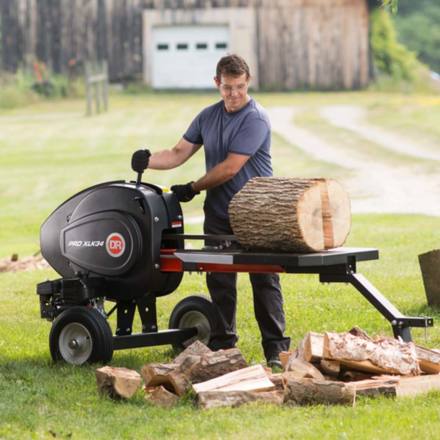
For gas powered models, DR has models K22 and K28. The K22 can split logs 18″ long and 30″ in diameter while the K28 is towable and can split logs 24″ long and up to 30″ in diameter. Their top of the line model is the XLK34 and it compares with 34 Ton hydraulic log splitters.

DR XLK 34 Kinetic Log Splitter
DR XLK34

Electric models include the Pilot K10 and the K22E. The K10 is the cheapest model and has a 1 second cycle time and can split logs up to 16″ long. The K22E is like its K22 counterpart and can split logs 18″ and up to 30″ in diameter.

Oregon Kinetic Log Splitter

Oregon Kinetic Log Splitter

Oregon has a line of log splitters and part of this line-up includes a kinetic log splitter. The Oregon Kinetic Log Splitter has a 34 Ton equivalent and can handle 24″ logs

Range Road Kinetic Log Splitter

Range Road Kinetic Log Splitter

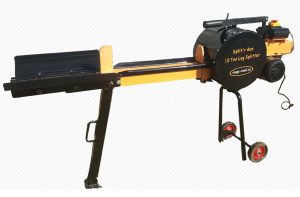
Range Road is a Canadian company that makes equipment for small to medium sized logging operations. One of the pieces of equipment they make is a kinetic log splitter. The Range Road Kinetic log splitter is electric and can split logs 20″

SpeeCo Kinetic log splitter

SpeeCo Commercial Kinetic Log Splitter

The SpeeCo Commercial Kinetic Log Splitter features a Kohler engine. It is also towable which is handy for getting it around. It has a 2 second cycle time.

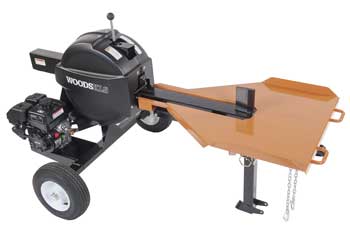
Woods kinetic log splitter

Woods Kinetic Log Splitter

The Woods Kinetic Log Splitter is a commercial/residential splitter that can split 24″ logs and features a 32″ table for working rounds. The unit is towable.

WoodMaxx LS-T34T Kinetic Log Splitter

WoodMaxx Kinetic Log Splitters

WoodMaxx is a another U.S. based manufacturer that makes two kinetic log splitter models. The first model is the LS-28T. It’s a 28 Ton equivalent log splitter that can split 24″ logs up to 28″ in diameter. The next model is the LS-34T. This model can also handle 24″ and 28″ in diameter.

Conclusion

As you can see, there are a number of different options for kinetic log splitters. Kinetic splitters have power and most importantly speed. They are a great choice if want to get the job done and have few logs with knotted wood. If none of these work for you, you can always take a look at electric log splitters or manual log splitters and see if anything there will work for you.

Hopefully this guide has been helpful in showing you the different options that are available. Check out our other exclusive Guides on LincOn.com

If you know of any other kinetic log splitters that should be on this list, please email Dave at dbroer@LincOn.com


Manual Log Splitters

Manual log splitters are log splitters that use mechanic leverage to split a log. These sometimes involve the same hydraulic rams that electric or gas powered log splitters use but it may use some other means to split the log. This guide focuses on different manual log splitters that are available and allows you to compare different models and see what is available.

How do splitters work

Typically, log splitters work by pushing a hydraulic ram. The ram is powered by a pump that pumps the hydraulic fluid. This pump can either be powered by a gas motor, an electric motor or manually activated.

Advantages/Disadvantages of Manual log splitters

Like anything else, there are advantages and disadvantages to using an manual log splitter. These may or may not affect you but should be taken into consideration when purchasing a log splitter.

Advantages

  • No gasoline needed
  • Relatively quiet
  • Can be used indoors/in enclosed spaces
  • Can be more powerful that

Disadvantages

  • Some options are less powerful
  • More effort needed than powered units for some options

Manual Log Splitter Models

Here are some electric log splitters to consider. The splitters are sorted by power.

Felled Slide Hammer Manual Log Splitter

Felled Slide Hammer Manual Log Splitter

The Felled Slide Hammer manual log splitter is another splitter that uses hammer force to split the log. You raise and lower a ram on the handle to give it the force to split logs.

Harbor Freight 10 Ton Hydraulic log Splitter
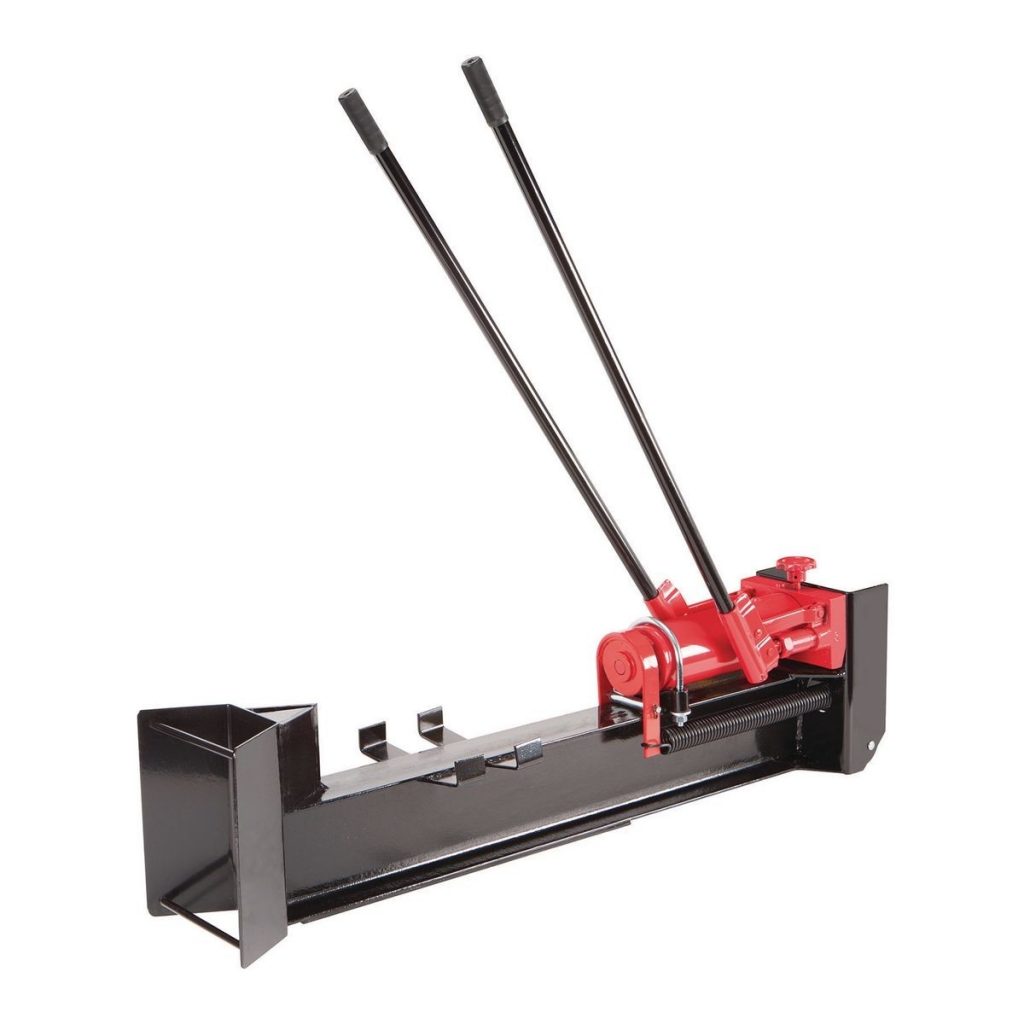
Harbor Freight 10 Ton Log Splitter

Harbor Freight 10 Ton Log Splitter

The Harbor Freight 10 Ton Hydraulic log splitter works much like a traditional log splitter by using a ram to press the log against a wedge. The ram is powered by cranking two levers back and forth to move the piston. At 10 tons it’s more capable than most electric splitters and can split logs up to 18″ long. This unit can also be ordered through Amazon.

Logosol Smart-Splitter 14 Ton Manual Log Splitter
Logo Smart-Splitter 14 Ton Manual Log Splitter

Logosol Smart-Splitter 14 Ton Manual Log Splitter

The Logosol Smart-Splitter 14 Ton manual log splitter is one of the more powerful log splitters on our list. It’s easy to use and can take logs up to 21.5″ long and any width. It works by simpy raising a weight and lettering and drop. You repeat this until the log is split.

Sun Joe 10 Ton Hydraulic Log Splitter

Sun Joe 10 Ton Hydraulic Log Splitter

The Sun Joe 10 Ton hydraulic log splitter looks and works very similarly to the Harbor Freight model. They both can take logs up to 18″ so they are probably made by the same manufacturer and just branded differently.

Timber Tuff Manual Log Splitter

Timber Tuff Manual Log Splitter

The Timber Tuff Manual Log Splitter works by raising and lowering a hammer weight built into the handle. This action splits the log.

Vulcan 8 Ton Manual Log Splitter

The Vulcan 8 Ton Manual Log Splitter is a vertical log splitter that uses a hydraulic ram that is powered by manually pumping the ram with your foot until the log splits. It can split logs up to 25″.

Wedges and Mauls

In addition to manually powered hydraulic rams and levels that provide mechanical advantage when splitting wood, other manual log splitters include traditional and non-traditional wedges and mauls. Here are some to consider.

Estwing Sure Split Wedge

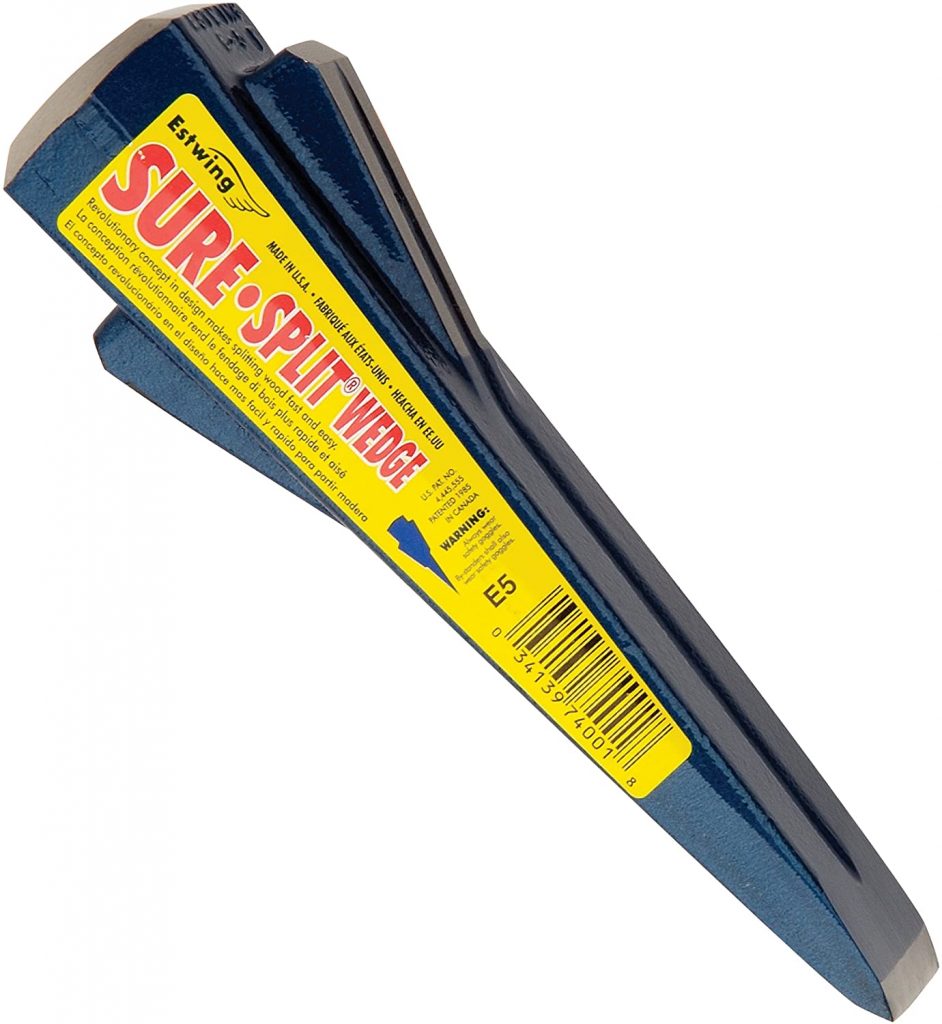
Estwing Sure Split Wedge

The Estwing Sure Split Wedge is a powerful wedge design. It helps split logs more easily due to its non-traditional design. This wedge is made in the U.S.A so you are sure to get a quality product.

Fiskars IsoCore Maul

The Fiskars IsoCore Maul is a 36″ long maul engineered with a special wedge to make splitting wood easier. The IsoCore technology means less impact to user when splitting a log.

Manual log splitting wedge

Manual Log Splitter Wedge

This Manual Log Splitter Wedge is a generic wedge that is pretty much a standard design. It features a four-way split and requires and 8lb+ sledge hammer to force it through a log.

Conclusion

As you can see, there are a number of different options for manual log splitters. They range from hydraulic rams, levers and even simple wedges so there is plenty to consider when looking for a log splitter. If none of these work for you, you can always take a look at electric log splitters or kinetic log splitters and see if anything there will work for you.

Hopefully this guide has been helpful in showing you the different options that are available. Check out our other exclusive Guides on LincOn.com

If you know of any other electric log splitters that should be on this list, please email Dave at dbroer@LincOn.com


Electric Log Splitters

Electric log splitters are log splitters that use electricity to power the hydraulic ram that splits the log. They have advantages over gas powered log splitters but are generally less powerful but are still very capable machines. This guide focuses on different electric log splitters that are available and allows you to compare different models and see what is available.

How do splitters work

Typically, log splitters work by pushing a hydraulic ram. The ram is powered by a pump that pumps the hydraulic fluid. This pump can either be powered by a gas motor, an electric motor or manually activated.

In this case, the hydraulic pump is powered by an electric motor. The hydraulic ram or piston presses the log against a wedge causing the log to split.

Advantages/Disadvantages of electric log splitters

Like anything else, there are advantages and disadvantages to using an electric log splitter. These may or may not affect you but should be taken into consideration when purchasing a log splitter.

Advantages

  • No gasoline needed
  • Relatively quiet
  • Can be used indoors/in enclosed spaces
  • Lower to the ground – can roll logs more easily onto it
  • Easy to start

Disadvantages

  • Electricity needed
  • Electric cord
  • Less powerful
  • Lower to the ground – potentially more bending needed

Electric Log Splitter Models

Here are some electric log splitters to consider. The splitters are sorted by power.

Earthquake 5 Ton Electric Log Splitter

Earthquake 5 Ton Electric Log Splitter

The Earthquake 5 Ton electric log splitter is another one of the smaller yet capable log splitters in our listing. It features a 1500 watt motor and can split logs up to 20″ in length. This model is also available with a stand.

Harbor Freight 5 Ton Electric Log Splitter

Harbor Freight 5 Ton Electric Log Splitter

The Harbor Freight 5 Ton electric log splitter is one of the smallest in the lineup but it’s a very capable 1.8HP splitter that can accommodate logs up to 18″ long.

Sun Joe 5 Ton Electric Log Splitter

Sun Joe 5 Ton Electric Log Splitter

The Sun Joe 5 Ton electric log splitter features a 15 amp motor and can split logs up to 20.5″.

Southland 6 Ton Electric Log Splitter

Southland 6 Ton Electric Log Splitter

The Southland 6 Ton electric log splitter features a unique design that allows it to be shifted so that you can split logs in the vertical as well as horzontal position. It can split logs up to 20.5″ long.

WEN 6.5 Ton Electric Log Splitter

WEN 6.5 Ton Electric Log Splitter

The WEN 6.5 tom electric log splitter is one of the few log splitters that comes on a stand which eliminates bending to load the logs but you will need to lift the logs into place. The splitter can handle logs 10.5″ in diameter and 20.5″ long.

Boss 7 Ton electric log splitter
Boss 7 Ton Electric Log Splitter

Boss 7 Ton Electric Log Splitter

The Boss 7 Ton electric log splitter can reportedly split logs over 20″ in diameter and features a 2HP motor that needs a 20A outlet to power it. It can split logs up to 20″ long making it a nice mid-range unit.

Powerhouse 7 Ton Electric Log Splitter

Powerhouse 7 Ton Electric Log Splitter

The Powerhouse 7 Ton electric log splitter is the smaller of the two Powerhouse-brand splitters on our list. It can split logs up to 20.5″ and claims to produce more force than the Boss 7 Ton log splitter so if you’re looking for a mid-range splitter, this one should make your list as well.

Stark 7 Ton Electric Log Splitter

Stark Industrial 7 Ton Electric Log Splitter

The Stark Industrial 7 Ton electric log splitter is another splitter in the mid-size range. It features a 1500 watt motor and is capable of splitting 21″ logs.

Powerhouse 9 Ton Electric Log Splitter
Powehouse 9 Ton Electric Log Splitter

Powerhouse 9 Ton Electric Log Splitter

The Powerhouse 9 Ton electric log splitter is one of the most powerful electric log splitters available. It can handle logs up to 20″. This unit can draw up to 2900 watts or 25 amps so make sure you have a powerful electric outlet!

Boss 10 Ton Electric Log Splitter

Boss 10 Ton Electric Log Splitter

The Boss 10 Ton Electric Log Splitter is one of the powerful electric splitters available. It requires a 20 Amp circuit to provide the power that the unit needs. It features a bi-directional wedge, an industrial wedge and the ability to split logs up to 22″ long.

Conclusion

As you can see, there are a number of different options for electric log splitters. They range in power from 5 tons all the way to 10 tons and can be floor height and some are available at a table height.

Hopefully this guide has been helpful in showing you the different options that are available. Check out our other exclusive Guides on LincOn.com

If you know of any other electric log splitters that should be on this list, please email Dave at dbroer@LincOn.com